
Configuring Provisioning Risk
Set which signals score application accounts, how strongly each one counts, the score bands for each level, and the level at which accounts raise detections. Override any of this for one application when it needs stricter or looser rules. Risk never holds or blocks provisioning; it informs the people who approve and review access.
Applications with provisioning set up and their accounts aggregated. See Aggregating Accounts and Entitlements.
Provisioning Risk – View (the same permission as Configuration → General) in an administrator group. Raise detections also needs ITDR – View, and ITDR – Edit to change it. Application overrides need Applications – View.
Setting risk signals
The signals are checked at every provisioning event and after each aggregation. Each enabled signal that fires adds to a 0–100 score.
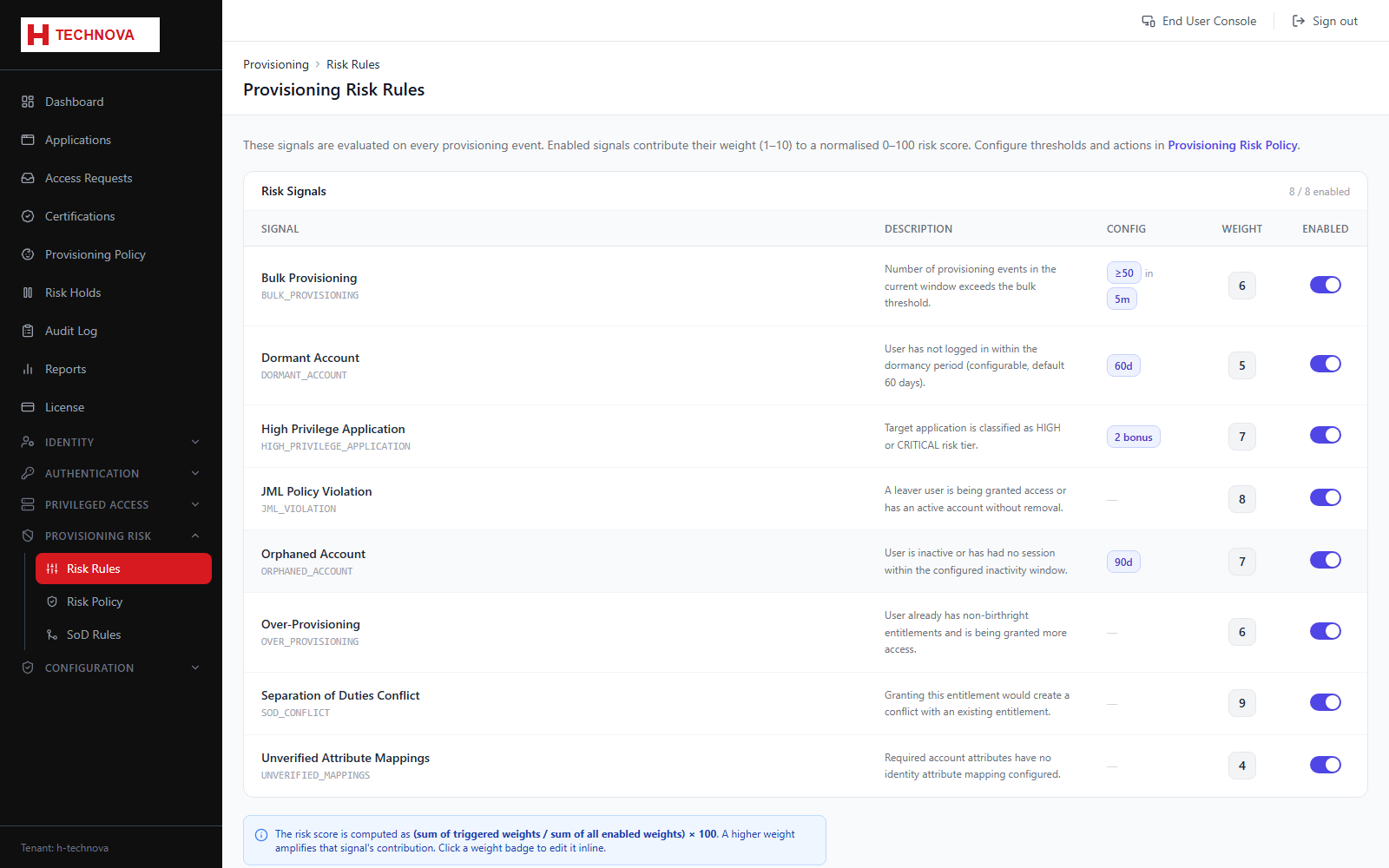
To set the provisioning risk signals:
- Go to Identity Security → Provisioning Risk. The Risk signals tab opens. The badge at the top right shows how many signals are enabled.
- Switch each signal on or off with its Enabled toggle.
- Select a signal's Weight badge to change it, from 1 to 10.
- Where a signal has its own settings, expand its row and change them. They save as you leave each field.
| Signal | Fires when | Settings |
|---|---|---|
| Certification Staleness | Access hasn't been certified recently, or the reviewer shows a rubber-stamp pattern. | Max days since cert (default 180), Reviewer approval rate (default 95%), Min sample size (default 10 decisions). |
| Direct Entitlement Assignment | An entitlement can't be traced to an approved request or birthright policy. | Grace period (default 14 days) and Scoring mode: Flat weight or Proportional to ungoverned share. |
| Dormant Account | The user hasn't been active within the dormancy period. | Dormancy period (default 60 days) and Evaluate from (account attribute). Auto uses session and last-modified history. If you name an attribute, you can add a Value transform. |
| Excessive Entitlements | The user holds many more entitlements than peers with the same value of an attribute. | Peer group attribute (default department), Minimum peer group size (default 5) and Value transform. |
| High Privilege Application | The application's risk tier is High or Critical. | Critical tier bonus (default 2), added to the weight for Critical applications. |
| JML Policy Violation | A leaver is being granted access, or still has an active account. | None. |
| Orphaned Account | No identity is correlated to the account. Found only during aggregation. | None. |
| Over-Provisioning | The user already has non-birthright entitlements and is being granted more. | None. |
| Privileged Access | The account holds, or would be given, a group, role or entitlement matching the privileged name patterns in Identity Security settings. | None. Set the patterns in Configuring Identity Security. |
| Separation of Duties Conflict | The grant would complete a conflict in an active SoD policy that flags new grants. | None. Set on the SoD policy; see Preventing Policy Violations. |
On its own, a weight 7 signal scores 47. With a weight 9 signal, the two score 79. See Provisioning and PAM risk for how scores combine.
Raising detections for risky accounts
To raise detections for risky accounts:
- Go to Identity Security → Provisioning Risk.
- Under Raise detections, choose the level: Critical, High or above (the default) or Medium or above.
- Switch it on.
An application or PAM account reaching this level opens a High-risk account detection in Identity Security, and your ITDR policies decide what happens next. This setting is shared with PAM Risk.
Setting risk levels
Levels describe a score. They don't hold or block anything.
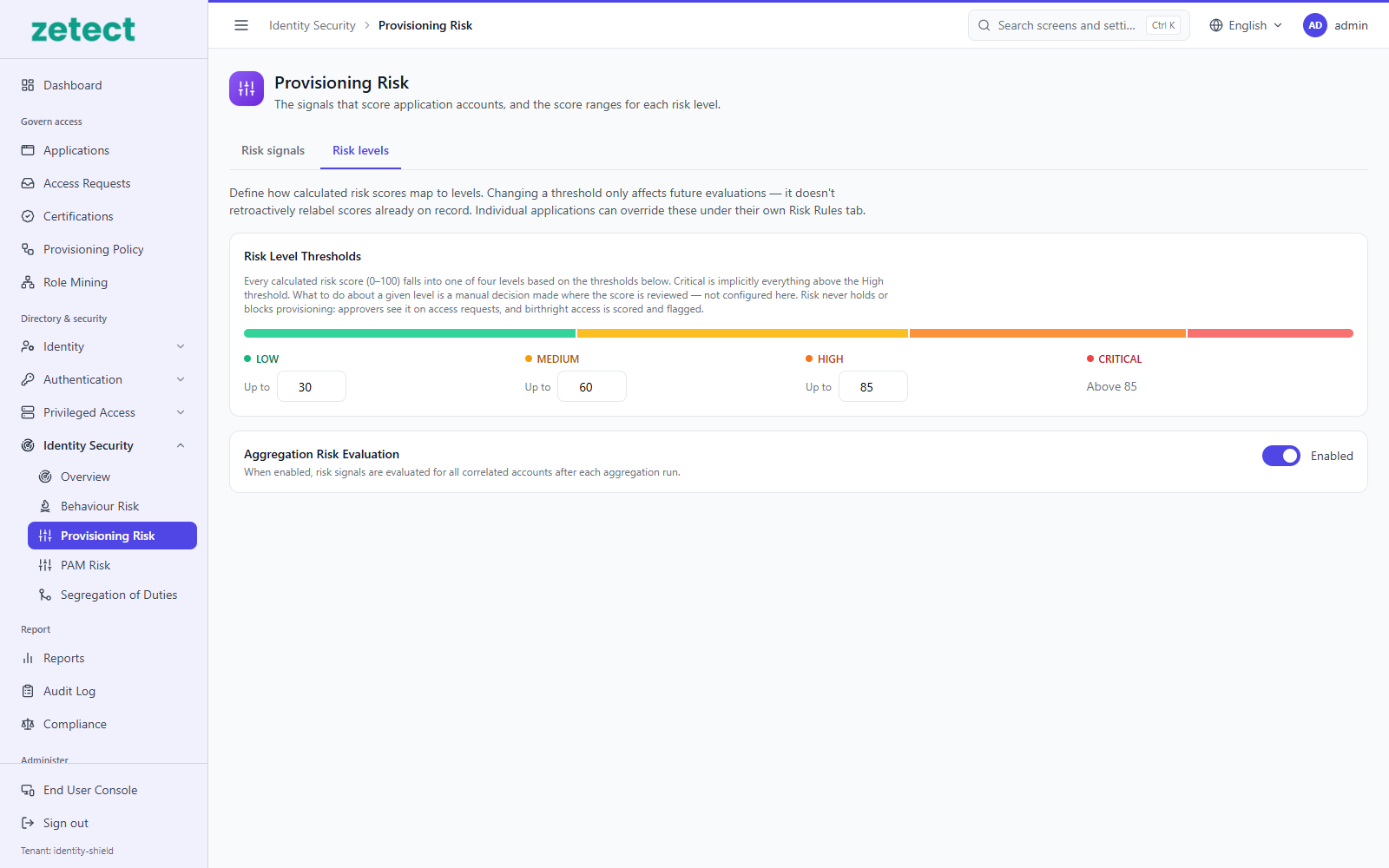
To set the provisioning risk levels:
- Go to Identity Security → Provisioning Risk and select the Risk levels tab.
- Under Risk Level Thresholds, enter the highest score for LOW (default 30), MEDIUM (default 60) and HIGH (default 85). CRITICAL is everything above the High threshold.
- Switch Aggregation Risk Evaluation on or off. When it is on, every correlated account is scored after each aggregation run, and the scores feed Identity Security.
- Select Save policy on the bar that appears, or Discard.
Thresholds must be whole numbers from 0 to 100 and must increase from Low to High. A change affects future evaluations only. These bands also set the level of each person's identity score.
Overriding risk for one application
An application can use a different weight, on/off state or setting for any signal, and different bands. Every override needs a reason, and the tenant default stays visible beside it.
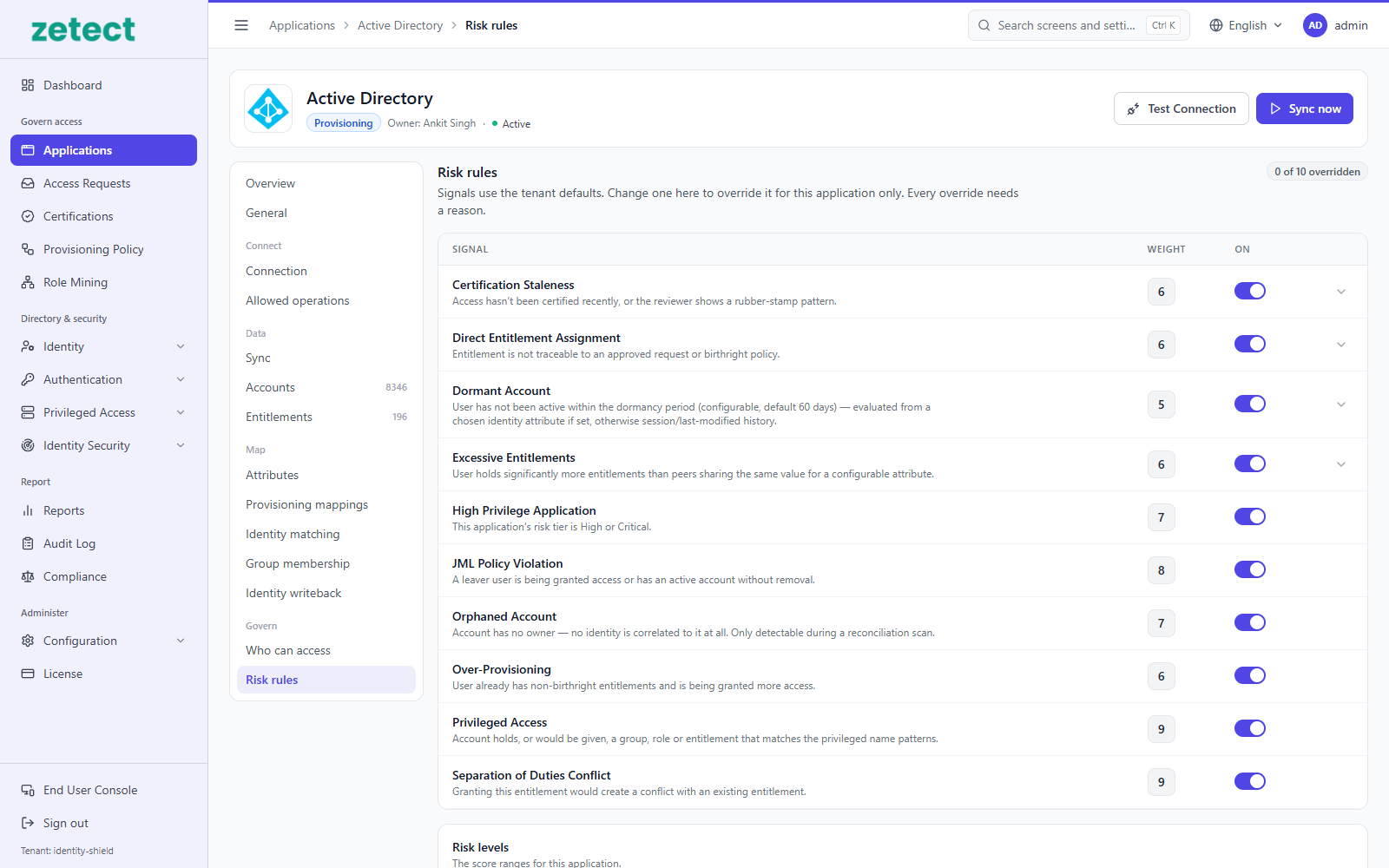
To override a signal for one application:
- Open the application and select Risk rules under Govern. The badge at the top right shows how many signals are overridden, for example "0 of 10 overridden".
- To change a signal's weight, select its number in the Weight column and enter the new value.
- To switch a signal on or off for this application, use its toggle in the On column.
- For Dormant Account, Excessive Entitlements, Direct Entitlement Assignment and Certification Staleness, select the arrow at the end of the row to change the signal's own settings.
- Type a Reason for this override.
- Select Save override, or Discard changes.
An overridden signal shows the tenant default weight and state beside it, and the saved reason under it. To change the bands for this application, edit the Risk levels card below the table, give a reason and select Save override. To remove an override, select Go back to the default under the signal or on the Risk levels card.
| Signal | Dormant Account |
| Weight | 8 (tenant default 5) |
| Dormancy period | 30 days |
| Reason | Payment approvers must use their access monthly under internal audit policy |
Troubleshooting
- An account has no score. Its application has no provisioning configuration, or no aggregation has run since the account appeared, or Aggregation Risk Evaluation is off.
- A high-risk account opened no detection. Check that Raise detections is on and set to a level the account reaches.